The Centaur’s arbitrage: Why the AI replacement panic is "Mathematically" wrong
The panic you feel is real, but it is misplaced. You are only obsolete if you insist on competing with the machine on its own turf.
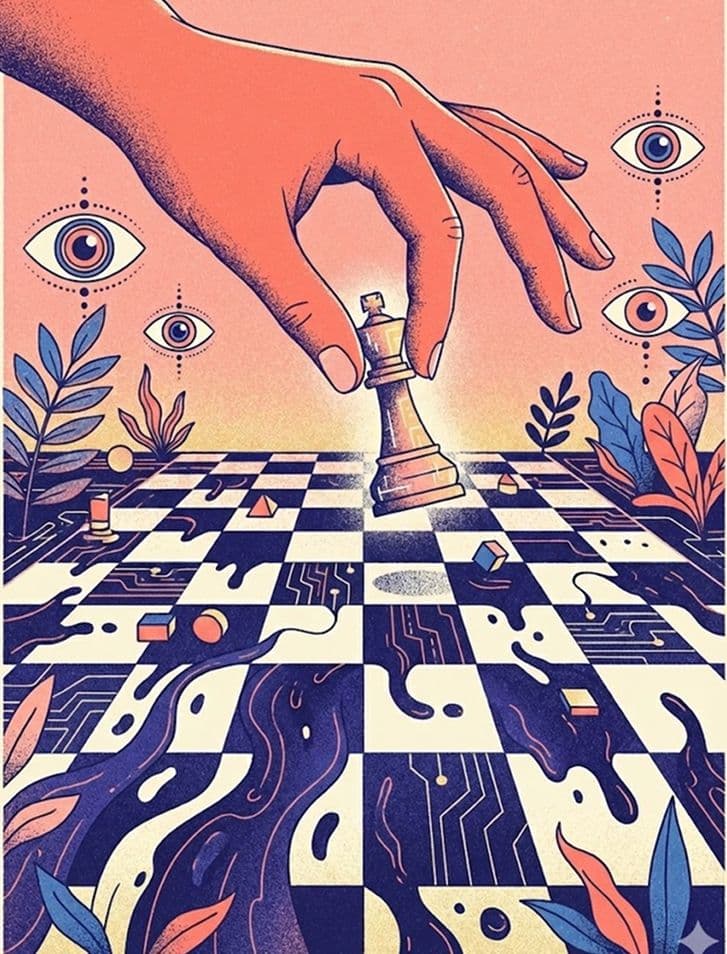
Is This A Zero-Sum Game?
We are currently living through a moment of extreme economic vertigo.
On one hand, you have the "Replacement Narrative." This is a Zero-Sum view of the world: There is a fixed amount of work. If an AI Agent can do it faster and cheaper than you, your value drops to zero.
On the other hand, you have the "Productivity Narrative." This is a Positive-Sum view: AI makes you 10x faster, so you will produce 10x more value.
The confusion stems from the fact that both feel true at the same time. You feel the potential for speed, but you also feel the encroaching obsolescence.
To resolve this, we have to look at the only industry that has already fully processed this trauma: Professional Chess.
The Data: 1997 vs. 2005
In 1997, Garry Kasparov lost to Deep Blue. The economic conclusion seemed obvious: The marginal value of human calculation had just dropped to zero.
But the story didn't end there. In 2005, a "Freestyle" chess tournament was held. This was an open market: Supercomputers could enter alone. Grandmasters could enter alone. Or they could team up.
If the "Replacement Narrative" were true, the standalone Supercomputer (highest raw compute) should have won. If the "Human Excellence" narrative were true, a Grandmaster using a computer (highest combined IQ) should have won.
Neither happened.
The winner was a team called ZackS—two amateur players using three mediocre chess engines on consumer hardware.
The Game Theory: Why The Amateurs Won
How did two amateurs destroy the strongest engines and the smartest humans?
They engaged in Arbitrage.
In economics, Comparative Advantage states that even if Entity A (The AI) is better at everything than Entity B (The Human), trade is still beneficial if they have different relative costs.
The AI’s Advantage (Tactics): Absolute dominance in calculation. It commits zero tactical errors. It is a "Minimax" machine—minimizing maximum loss perfectly.
The Human’s Advantage (Strategy): Absolute dominance in evaluation. Humans understand long-term intent and "closed positions" where calculation is useless because the game tree is too deep.
The Grandmasters lost because of Ego. They treated the AI as a junior partner and overruled it too often. They failed to allocate resources efficiently. The Supercomputers lost because of Tunnel Vision. They optimized for the next 10 moves perfectly but missed the 50-move strategy.
The amateurs won because they acted as Asset Managers. They didn't try to play chess. They played a meta-game of managing the chess engines. They knew exactly when the engine was hallucinating (a specific weakness of chess engines in "locked" positions) and when to trust it blindly.
The Insight: Moving Up the Value Chain
This clears the confusion about your job in 2025.
If your job is purely Execution (Tactics)—writing boilerplate code, drawing standard UI patterns, writing SEO summaries—you are in direct competition with a machine that has a marginal cost of zero. You are in a Substitution Crisis.
But if you shift your role to Allocation (Strategy), the math changes.
The Centaur approach is not about being "faster." It is about Error Correction. AI models today are probabilistic. They are brilliant but prone to drift. They are high-variance. Humans are lower-variance but lower-output.
The new economic value isn't "doing the work." It is verifying the work.
The Junior Developer writes code. The Centaur audits the AI's code for security flaws.
The Junior Designer draws pixels. The Centaur curates the AI's generations for brand alignment.
The Centaur Window
However, we must be honest about the data. In the world of professional chess, the "Freestyle" era was a transitional phase. Eventually, engines like Stockfish and AlphaZero became so advanced that human intervention transformed from an asset into a bottleneck. The window closed.
The economy, however, is not a closed system like an 8x8 chess board. It is infinite, chaotic, and messy. Because of this complexity, the "Freestyle" window in business will remain open longer—but not forever.
This creates a specific strategic urgency. For the next 3–5 years, becoming a "Centaur" is the only viable strategy to avoid obsolescence.
We are currently in a "Golden Era" of friction. The models are powerful enough to do the heavy lifting, but "dumb" enough to require human guidance. If you spend this window trying to out-code or out-write the AI, you will lose. But if you spend this window cultivating the taste, the intuition, and the strategic vision that directs the AI, you secure your position as the Orchestrator. When the window eventually closes and the models become fully autonomous, you won't be the laborer they replaced; you will be the owner of the system they run on.
Conclusion
The panic you feel is real, but it is misplaced. You are only obsolete if you insist on competing with the machine on its own turf (Calculation).
If you adopt the Centaur Strategy, you are no longer a laborer competing with automation. You are a Manager allocating infinite, cheap labor toward a strategic goal.
The amateurs didn't beat the Grandmasters because they were smarter. They won because they had a better process.